%load_ext autoreload
%autoreload 2
The autoreload extension is already loaded. To reload it, use:
  %reload_ext autoreload
from pathlib import Path
from typing import Literal

from matplotlib import pyplot as plt
from shapely.geometry import Point
from scipy.interpolate import interp1d
from scipy.signal import find_peaks
import numpy as np

from s2shores.bathy_debug.spatial_correlation_bathy_estimator_debug import SpatialCorrelationBathyEstimatorDebug
from s2shores.bathy_debug.spatial_correlation_wave_fields_display import (
    build_sinograms_spatial_correlation,
    build_waves_images_spatial_correl,
)

from s2shores.bathy_physics import celerity_offshore, period_offshore, wavelength_offshore
from s2shores.generic_utils.image_filters import circular_masking
from s2shores.generic_utils.image_utils import normalized_cross_correlation
from s2shores.generic_utils.signal_utils import find_period_from_zeros
from s2shores.generic_utils.symmetric_radon import symmetric_radon
from s2shores.bathy_debug.display_utils import get_display_title_with_kernel
from s2shores.bathy_debug.sinogram_display import (
    build_sinogram_display,
    build_sinogram_difference_display,
    build_sinogram_1D_display_master,
    build_sinogram_1D_cross_correlation,
    build_sinogram_1D_display_slave,
    build_sinogram_2D_cross_correlation,
)
from s2shores.global_bathymetry.bathy_config import (
    BathyConfig,
    GlobalEstimatorConfig,
    SpatialCorrelationConfig,
)
from s2shores.waves_exceptions import WavesEstimationError, NotExploitableSinogram
from utils import (
    initialize_sequential_run,
    read_config,
    plot_waves_row,
    build_ortho_sequence,
    plot_whole_image,
)
In case of a specfic server setup, specify the paths for
- os.environ["PROJ_DATA"]
- os.environ["GDAL_DATA"]
- os.environ["GDAL_DRIVER_PATH"]
- os.environ["CONDA_PREFIX"]
"""
import os
os.environ["PROJ_DATA"]="..../share/proj"
os.environ["GDAL_DATA"]="..../share/gdal"
os.environ["GDAL_DRIVER_PATH"]="..../lib/gdalplugins"
os.environ["CONDA_PREFIX"]="..../s2shores"
"""
Coastal Bathymetry Estimation via Spatial Correlation
Notebook Objective
This notebook provides an experimental and interactive environment to: - explore and adjust the key processing steps, - quickly test different parameters and method variations, - support iterative development of the processing workflow in a prototyping context. ## Notebook Summary
Preprocess the images: Apply filters on the images.
Find the direction: Calculate the main propagation direction of the waves.
Compute the Radon transforms: Compute Radon transforms on all images.
Compute the spatial correlation: Compute the spatial correlations of the radon transform on the main direction.
Compute the wavelength: Compute the wavelength of the waves based on the period of the spatial correlation.
Compute the delta position: Compute the depth estimation from the wavelength.
base_path = Path("../tests/data/products").resolve()
test_case: Literal["7_4", "8_2"] = "8_2"
method: Literal["spatial_corr", "spatial_dft", "temporal_corr"] = "spatial_corr"

product_path: Path = base_path / "products" / f"SWASH_{test_case}/testcase_{test_case}.tif"
config_path: Path = base_path / f"reference_results/debug_pointswash_{method}/wave_bathy_inversion_config.yaml"
debug_file: Path = base_path / f"debug_points/debug_points_SWASH_{test_case}.yaml"
# config = read_config(config_path=config_path)

# OR

config = BathyConfig(
    GLOBAL_ESTIMATOR=GlobalEstimatorConfig(
        WAVE_EST_METHOD="SPATIAL_CORRELATION",
        SELECTED_FRAMES=[10, 13],
        DXP=50,
        DYP=500,
        NKEEP=5,
        WINDOW=400,
        SM_LENGTH=100,
        MIN_D=2,
        MIN_T=3,
        MIN_WAVES_LINEARITY=0.01,
    )
)
If you want to change any parameter of the configuration, modify the
values of the object config by overriding the values of the
attributes.
Example:
config.parameter = "new_value"
bathy_estimator, ortho_bathy_estimator = initialize_sequential_run(
    product_path=product_path,
    config=config,
    delta_time_provider=None,
)

plt_min = bathy_estimator.local_estimator_params['DEBUG']['PLOT_MIN']
plt_max = bathy_estimator.local_estimator_params['DEBUG']['PLOT_MAX']
/home/geoffrey/miniconda3/envs/env_name/lib/python3.12/site-packages/distributed/node.py:187: UserWarning: Port 8787 is already in use.
Perhaps you already have a cluster running?
Hosting the HTTP server on port 44025 instead
  warnings.warn(
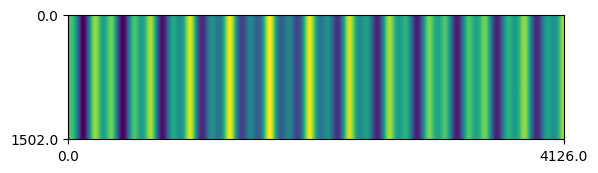
estimation_point = Point(451.0, 499.0)
ortho_sequence = build_ortho_sequence(ortho_bathy_estimator, estimation_point)
local_estimator = SpatialCorrelationBathyEstimatorDebug(
    estimation_point,
    ortho_sequence,
    bathy_estimator,
)

if not local_estimator.can_estimate_bathy():
    raise WavesEstimationError("Cannot estimate bathy.")
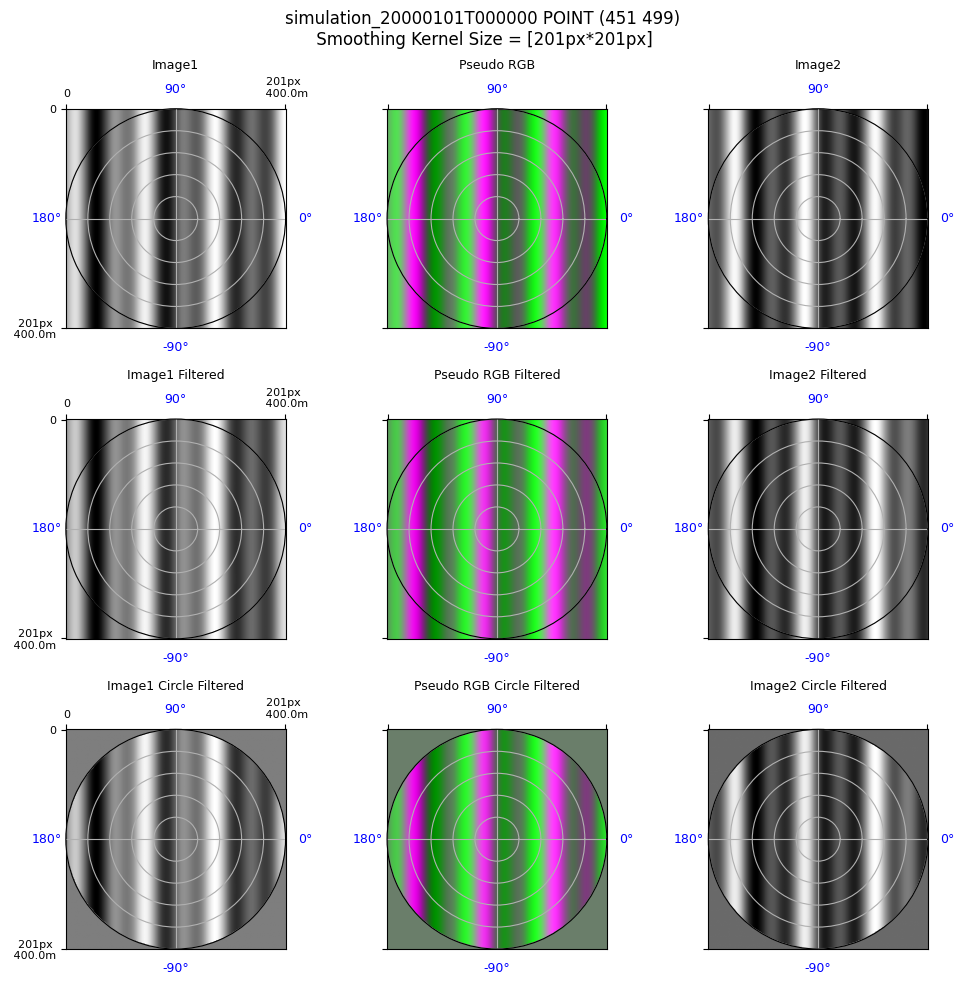
Preprocess images
Modified attributes: - local_estimator.ortho_sequence.<elements>.pixels
from s2shores.generic_utils.image_filters import desmooth, detrend

def custom_filter(img, param1, param2):
    """My custom filter."""
    return img


if False:
    local_estimator.preprocess_images()
else:
    preprocessing_filters = [(detrend, [])]

    if bathy_estimator.smoothing_requested:
        # FIXME: pixels necessary for smoothing are not taken into account, thus
        # zeros are introduced at the borders of the window.

        preprocessing_filters += [
            (desmooth,
             [bathy_estimator.smoothing_lines_size,
              bathy_estimator.smoothing_columns_size]),
            # Remove tendency possibly introduced by smoothing, specially on the shore line
            (detrend, []),
            # Add your custom filters here
            # Ex: (custom_filter, [param1, param2])
        ]


    for image in local_estimator.ortho_sequence:
        filtered_image = image.apply_filters(preprocessing_filters)
        image.pixels = filtered_image.pixels
Display processed images
if False:
    build_waves_images_spatial_correl(local_estimator)
else:
    nrows = 3
    ncols = 3
    fig, axs = plt.subplots(nrows=nrows, ncols=ncols, figsize=(10, 10))
    fig.suptitle(get_display_title_with_kernel(local_estimator), fontsize=12)

    first_image = local_estimator.ortho_sequence[0]
    second_image = local_estimator.ortho_sequence[1]

    # First Plot line = Image1 / pseudoRGB / Image2
    plot_waves_row(fig=fig,
                   axs=axs,
                   row_number=0,
                   pixels1=first_image.original_pixels,
                   resolution1=first_image.resolution,
                   pixels2=second_image.original_pixels,
                   resolution2=first_image.resolution,
                   nrows=3,
                   ncols=3)
    # Second Plot line = Image1 Filtered / pseudoRGB Filtered/ Image2 Filtered
    plot_waves_row(fig=fig,
                   axs=axs,
                   row_number=1,
                   pixels1=first_image.pixels,
                   resolution1=first_image.resolution,
                   pixels2=second_image.pixels,
                   resolution2=first_image.resolution,
                   title_suffix=" Filtered",
                   nrows=3,
                   ncols=3)

    # Third Plot line = Image1 Circle Filtered / pseudoRGB Circle Filtered/ Image2 Circle Filtered
    plot_waves_row(fig=fig,
                   axs=axs,
                   row_number=2,
                   pixels1=first_image.pixels * first_image.circle_image,
                   resolution1=first_image.resolution,
                   pixels2=second_image.pixels * second_image.circle_image,
                   resolution2=first_image.resolution,
                   title_suffix=" Circle Filtered",
                   nrows=3,
                   ncols=3)
    plt.tight_layout()
Find direction
New variables: - estimated_direction
if False:
    main_direction = local_estimator.find_direction()
else:
    # Start: WavesRadon(self.ortho_sequence[0], self.selected_directions)
    image = local_estimator.ortho_sequence[0]
    sampling_frequency = 1. / image.resolution
    selected_directions = local_estimator.selected_directions

    pixels = circular_masking(image.pixels.copy())
    radon_transform = symmetric_radon(image=pixels, theta=selected_directions)

    waves_radon = {
        direction: radon_transform[:, idx]
        for idx, direction in enumerate(selected_directions)
    }
    # End: WavesRadon


    # Start: WavesRadon.get_direction_maximum_variance()

    # Start: Sinograms.get_sinograms_variances(selected_directions)
    variances = np.empty(len(selected_directions), dtype=np.float64)
    for result_index, direction in enumerate(selected_directions):
        variances[result_index] = float(np.var(waves_radon[direction]))
    # End: Sinograms.get_sinograms_variances

    index_max_variance = np.argmax(variances)
    main_direction = selected_directions[index_max_variance]
    # End: WavesRadon.get_direction_maximum_variance

main_direction
-180.0
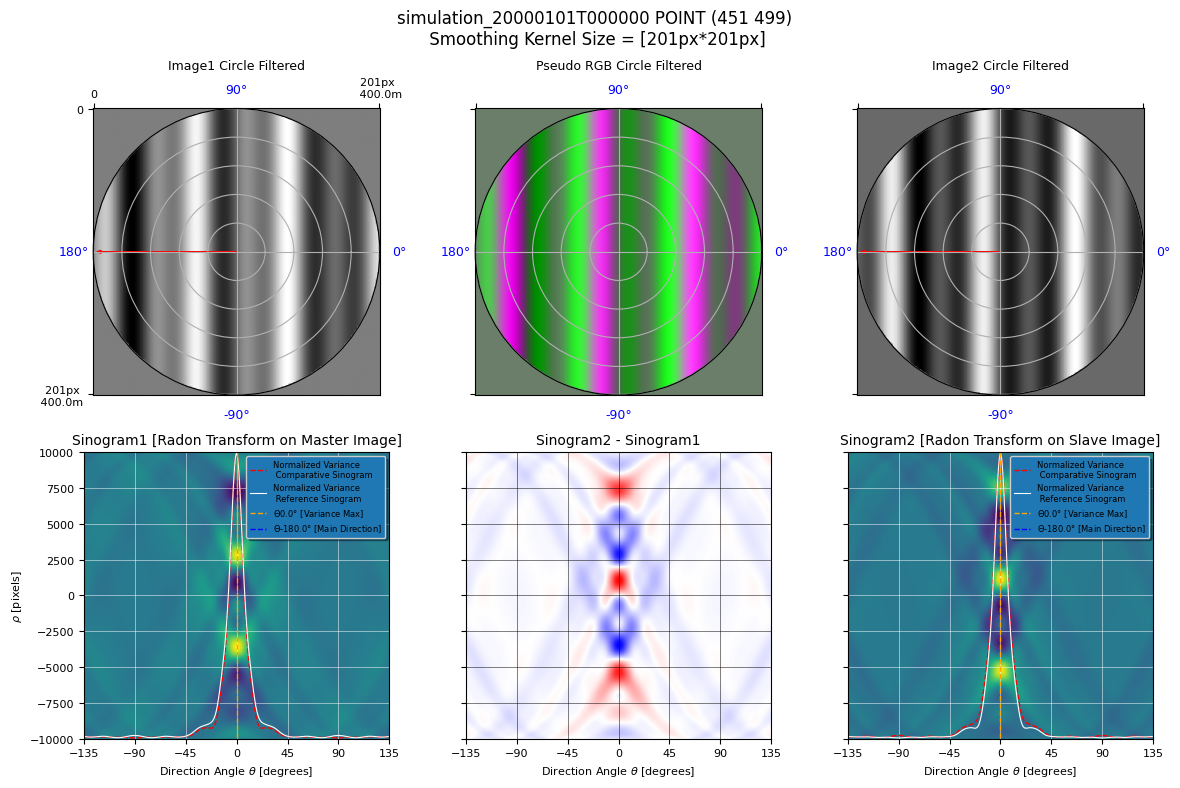
Compute radon transforms
New elements: - local_estimator.randon_transforms
from s2shores.image_processing.waves_radon import linear_directions

# For debugging, all plotted directions need to be computed
min_dir = min(plt_min, min(local_estimator.selected_directions))
max_dir = max(plt_max, max(local_estimator.selected_directions))
selected_directions = linear_directions(angle_min=min_dir, angle_max=max_dir, angles_step=1)

# Reset radon transforms when cell is re-run
local_estimator.radon_transforms = []

if False:
    local_estimator.compute_radon_transforms(main_direction)
else:
    for image in local_estimator.ortho_sequence:
        # Start: WavesRadon(image, np.array([estimated_direction]))
        sampling_frequency = 1. / image.resolution

        pixels = circular_masking(image.pixels.copy())
        radon_transform = symmetric_radon(image=pixels, theta=selected_directions)

        waves_radon = {
            direction: radon_transform[:, idx]
            for idx, direction in enumerate(selected_directions)
        }
        # End: WavesRadon

        # Start: Sinograms.radon_augmentation(self.radon_augmentation_factor)
        radon_augmented = {}
        for direction, values in waves_radon.items():
            current_axis = np.linspace(0, values.size - 1, values.size)
            nb_over_samples = round(((values.size - 1) / local_estimator.radon_augmentation_factor) + 1)
            new_axis = np.linspace(
                start=0,
                stop=values.size - 1,
                num=nb_over_samples,
            )
            interpolating_func = interp1d(current_axis, values, kind='linear', assume_sorted=True)
            radon_augmented[direction] = interpolating_func(new_axis)
        # End: Sinograms.radon_augmentation(self.radon_augmentation_factor)

        local_estimator.radon_transforms.append(radon_augmented)
if False:
    # Use this when computing radon transforms with the standard method
    build_sinograms_spatial_correlation(local_estimator, main_direction)
else:
    nrows = 2
    ncols = 3
    fig, axs = plt.subplots(nrows=nrows, ncols=ncols, figsize=(12, 8))
    fig.suptitle(get_display_title_with_kernel(local_estimator), fontsize=12)
    first_image = local_estimator.ortho_sequence[0]
    second_image = local_estimator.ortho_sequence[1]

    arrows = [(main_direction, np.shape(first_image.original_pixels)[0])]

    # First Plot line = Image1 Circle Filtered / pseudoRGB Circle Filtered/ Image2 Circle Filtered
    plot_waves_row(
        fig=fig,
        axs=axs,
        row_number=0,
        pixels1=first_image.pixels * first_image.circle_image,
        resolution1=first_image.resolution,
        pixels2=second_image.pixels * second_image.circle_image,
        resolution2=first_image.resolution,
        nrows=nrows,
        ncols=ncols,
        title_suffix=" Circle Filtered",
        directions=arrows,
    )

    # Second Plot line = Sinogram1 / Sinogram2-Sinogram1 / Sinogram2
    first_radon_transform = local_estimator.radon_transforms[0]
    second_radon_transform = local_estimator.radon_transforms[1]


    first_iter = next(iter(first_radon_transform.values()))
    nb_samples = first_iter.shape[0]

    sinogram1 = np.empty((nb_samples, len(selected_directions)))
    sinogram2 = np.empty((nb_samples, len(selected_directions)))

    for index, direction in enumerate(selected_directions):
        sinogram1[:, index] = first_radon_transform[direction]
        sinogram2[:, index] = second_radon_transform[direction]

    radon_difference = (
        (sinogram2 / np.abs(sinogram2).max())
        - (sinogram1 / np.abs(sinogram1).max())
    )

    build_sinogram_display(
        axes=axs[1, 0],
        title='Sinogram1 [Radon Transform on Master Image]',
        values1=sinogram1,
        directions=selected_directions,
        values2=sinogram2,
        main_theta=main_direction,
        plt_min=plt_min,
        plt_max=plt_max,
    )
    build_sinogram_difference_display(
        axes=axs[1, 1],
        title='Sinogram2 - Sinogram1',
        values=radon_difference,
        directions=selected_directions,
        plt_min=plt_min,
        plt_max=plt_max,
        cmap='bwr',
    )
    build_sinogram_display(
        axes=axs[1, 2],
        title='Sinogram2 [Radon Transform on Slave Image]',
        values1=sinogram2,
        directions=selected_directions,
        values2=sinogram1,
        main_theta=main_direction,
        plt_min=plt_min,
        plt_max=plt_max,
        ordonate=False,
    )

    plt.tight_layout()
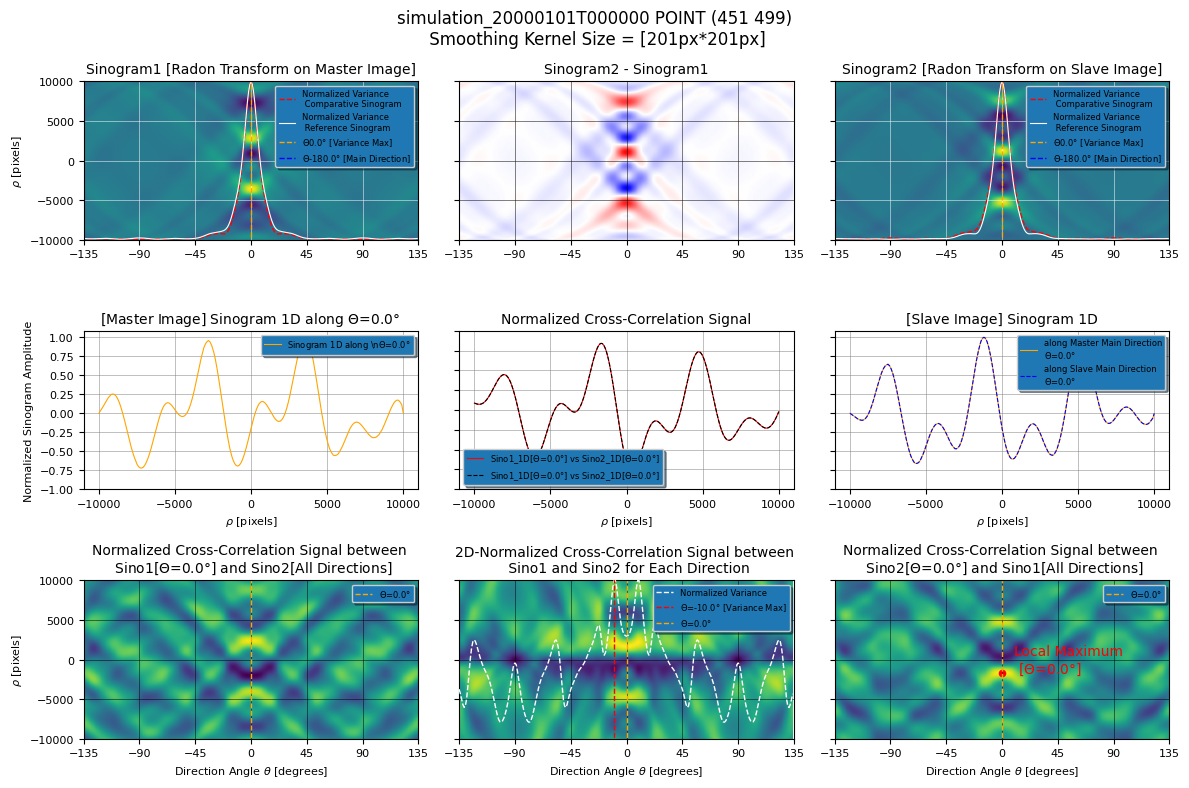
Compute spatial correlation
New elements: - local_estimator.sinograms
New variables: - correlation_signal
local_estimator.sinograms = []

if False:
    correlation_signal = local_estimator.compute_spatial_correlation(main_direction)
else:
    for radon_transform in local_estimator.radon_transforms:
        values = radon_transform[main_direction]
        values *= float(np.var(values))
        local_estimator.sinograms.append(values)
    # TODO: should be independent from 0/1 (for multiple pairs of frames)
    sinogram_1 = local_estimator.sinograms[0]
    sinogram_2 = local_estimator.sinograms[1]
    correl_mode = local_estimator.local_estimator_params['CORRELATION_MODE']
    corr_init = normalized_cross_correlation(sinogram_1, sinogram_2, correl_mode)
    corr_init_ac = normalized_cross_correlation(corr_init, corr_init, correl_mode)
    corr_1 = normalized_cross_correlation(corr_init_ac, sinogram_1, correl_mode)
    corr_2 = normalized_cross_correlation(corr_init_ac, sinogram_2, correl_mode)
    correlation_signal = normalized_cross_correlation(corr_1, corr_2, correl_mode)

correlation_signal
array([0.17217606, 0.17246987, 0.17276372, ..., 0.13137046, 0.13173335,
       0.13209611])
nrows = 3
ncols = 3
fig, axs = plt.subplots(nrows=nrows, ncols=ncols, figsize=(12, 8))
fig.suptitle(get_display_title_with_kernel(local_estimator), fontsize=12)


# First Plot line = Sinogram1 / Sinogram2-Sinogram1 / Sinogram2
radon_difference = (sinogram2 / np.max(np.abs(sinogram2))) - \
    (sinogram1 / np.max(np.abs(sinogram1)))

build_sinogram_display(
    axes=axs[0, 0],
    title='Sinogram1 [Radon Transform on Master Image]',
    values1=sinogram1,
    directions=selected_directions,
    values2=sinogram2,
    plt_min=plt_min,
    plt_max=plt_max,
    main_theta=main_direction,
    abscissa=False,
)
build_sinogram_difference_display(
    axs[0, 1],
    'Sinogram2 - Sinogram1',
    radon_difference,
    selected_directions,
    plt_min,
    plt_max,
    abscissa=False,
    cmap='bwr',
)
build_sinogram_display(
    axes=axs[0, 2],
    title='Sinogram2 [Radon Transform on Slave Image]',
    values1=sinogram2,
    directions=selected_directions,
    values2=sinogram1,
    plt_min=plt_min,
    plt_max=plt_max,
    main_theta=main_direction,
    ordonate=False,
    abscissa=False,
)

# Second Plot line = SINO_1 [1D along estimated direction] / Cross-Correlation Signal /
# SINO_2 [1D along estimated direction resulting from Image1]
# Check if the main direction belongs to the plotting interval [plt_min:plt_max]
if main_direction < plt_min or main_direction > plt_max:
    theta_label = main_direction % (-np.sign(main_direction) * 180.0)
else:
    theta_label = main_direction
title_sino1 = '[Master Image] Sinogram 1D along $\\Theta$={:.1f}° '.format(theta_label)
title_sino2 = '[Slave Image] Sinogram 1D'.format(theta_label)
correl_mode = local_estimator.global_estimator.local_estimator_params['CORRELATION_MODE']

build_sinogram_1D_display_master(
    axs[1, 0],
    title_sino1,
    sinogram1,
    selected_directions,
    main_direction,
    plt_min,
    plt_max,
)
build_sinogram_1D_cross_correlation(
    axs[1, 1],
    'Normalized Cross-Correlation Signal',
    sinogram1,
    selected_directions,
    main_direction,
    sinogram2,
    selected_directions,
    plt_min,
    plt_max,
    correl_mode,
    ordonate=False,
)
build_sinogram_1D_display_slave(
    axs[1, 2],
    title_sino2,
    sinogram2,
    selected_directions,
    main_direction,
    plt_min,
    plt_max,
    ordonate=False,
)

# Third Plot line = Image [2D] Cross correl Sino1[main dir] with Sino2 all directions /
# Image [2D] of Cross correlation 1D between SINO1 & SINO 2 for each direction /
# Image [2D] Cross correl Sino2[main dir] with Sino1 all directions
# Check if the main direction belongs to the plotting interval [plt_min:plt_ramax]

title_cross_correl1 = 'Normalized Cross-Correlation Signal between \n Sino1[$\\Theta$={:.1f}°] and Sino2[All Directions]'.format(
    theta_label)
title_cross_correl2 = 'Normalized Cross-Correlation Signal between \n Sino2[$\\Theta$={:.1f}°] and Sino1[All Directions]'.format(
    0)
title_cross_correl_2D = '2D-Normalized Cross-Correlation Signal between \n Sino1 and Sino2 for Each Direction'

build_sinogram_2D_cross_correlation(
    axs[2, 0],
    title_cross_correl1,
    sinogram1,
    selected_directions,
    main_direction,
    sinogram2,
    plt_min,
    plt_max,
    correl_mode,
    choice='one_dir',
    imgtype='master',
)
build_sinogram_2D_cross_correlation(
    axs[2, 1],
    title_cross_correl_2D,
    sinogram1,
    selected_directions,
    main_direction,
    sinogram2,
    plt_min,
    plt_max,
    correl_mode,
    choice='all_dir',
    imgtype='master',
    ordonate=False,
)
build_sinogram_2D_cross_correlation(
    axs[2, 2],
    title_cross_correl2,
    sinogram2,
    selected_directions,
    main_direction,
    sinogram1,
    plt_min,
    plt_max,
    correl_mode,
    choice='one_dir',
    imgtype='slave',
    ordonate=False,
)

plt.tight_layout()
Compute wavelength
Modified attributes: - None
New variables: - wavelength
if False:
    wavelength = local_estimator.compute_wavelength(correlation_signal)
else:
    min_wavelength = wavelength_offshore(
        local_estimator.global_estimator.waves_period_min,
        local_estimator.gravity,
    )
    min_period_unitless = int(min_wavelength / local_estimator.augmented_resolution)
    try:
        # Depending on the input signal, the resulting period is either in space or time (in this case, space)
        period, _ = find_period_from_zeros(correlation_signal, min_period_unitless)
        wavelength = period * local_estimator.augmented_resolution
    except ValueError as excp:
        raise NotExploitableSinogram('Wave length can not be computed from sinogram') from excp

wavelength
134.68150021791905
Compute delta position
Modified attributes: - None
New variables: - delta_position
if False:
    delta_position = local_estimator.compute_delta_position(correlation_signal, wavelength)
else:
    peaks_pos, _ = find_peaks(correlation_signal)
    if peaks_pos.size == 0:
        raise WavesEstimationError('Unable to find any directional peak')
    argmax_ac = len(correlation_signal) // 2
    relative_distance = (peaks_pos - argmax_ac) * local_estimator.augmented_resolution

    celerity_offshore_max = celerity_offshore(
        local_estimator.global_estimator.waves_period_max,
        local_estimator.gravity,
    )
    spatial_shift_offshore_max = celerity_offshore_max * local_estimator.propagation_duration
    spatial_shift_min = min(-spatial_shift_offshore_max, spatial_shift_offshore_max)
    spatial_shift_max = -spatial_shift_min

    stroboscopic_factor_offshore = local_estimator.propagation_duration / period_offshore(
        1 / wavelength, local_estimator.gravity)

    if abs(stroboscopic_factor_offshore) >= 1:
        # unused for s2
        print('test stroboscopie vrai')
        spatial_shift_offshore_max = (
            local_estimator.local_estimator_params['PEAK_POSITION_MAX_FACTOR']
            * stroboscopic_factor_offshore
            * wavelength
        )

    pt_in_range = peaks_pos[np.where(
        (relative_distance >= spatial_shift_min)
        & (relative_distance < spatial_shift_max)
    )]
    if pt_in_range.size == 0:
        raise WavesEstimationError('Unable to find any directional peak')
    argmax = pt_in_range[correlation_signal[pt_in_range].argmax()]
    delta_position = (argmax - argmax_ac) * local_estimator.augmented_resolution

delta_position
-38.800000000000004
Save wave field estimation
New elements: - local_estimator.bathymetry_estimations
if False:
    local_estimator.save_wave_field_estimation(main_direction, wavelength, delta_position)
else:
    bathymetry_estimation = local_estimator.create_bathymetry_estimation(main_direction, wavelength)
    bathymetry_estimation.delta_position = delta_position
    local_estimator.bathymetry_estimations.append(bathymetry_estimation)

print(f"Physical: {local_estimator.bathymetry_estimations[0].is_physical()}")
print(local_estimator.bathymetry_estimations[0])
Physical: True
Geometry:   direction: 0.0° wavelength: 134.68 (m) wavenumber: 0.007425 (m-1)
Dynamics:   period: 10.41 (s)  celerity: 12.93 (m/s)
Wave Field Estimation:
  delta time: 3.000 (s) stroboscopic factor: 0.288 (unitless)
  delta position: 38.80 (m)  delta phase:  1.81 (rd)
Bathymetry inversion: depth: 23.43 (m)  gamma: 0.798  offshore period:  9.30 (s)  shallow water period: 30.45 (s)  relative period:  0.89  relative wavelength:  1.25  gravity: 9.780 (s)
Bathymetry Estimation:  stroboscopic factor low depth: 0.099  stroboscopic factor offshore: 0.323